Amazon DSP and freight driver jobs Nevada listings that mention “paid time off” leave several questions unanswered. Which employer supplies the benefit? Does the policy accrue leave as you work or provide it at the beginning of a benefit year? When can a new employee use the hours? Nevada Revised Statutes 608.0197 supplies specific paid-leave provisions, but its scope and exceptions must be checked before treating them as a promise attached to every delivery job.
Use the leave discussion to obtain the actual policy that applies to the proposed employment. A directory company name, driver count, or station association cannot determine whether the statute covers that employer or how a particular policy works. An applicant should compare the written terms with the statutory provisions and keep any unanswered applicability question visible.
This guide focuses on Nevada paid-leave accrual, availability, and use under NRS 608.0197. It addresses employee leave terms, not leave benefits for every person doing delivery work under any arrangement. Federal family and medical leave has a separate eligibility review; paid leave and federal job protection need separate answers.
Identify the employer and applicable Nevada paid-leave policy
NRS 608.0197 defines “employer” for this section as a private employer with fifty or more employees in private employment in Nevada. That is a statutory employer definition, not a count of familiar drivers at one station. Confirm the employer named in the proposed employment documents and ask it to explain the basis for its paid-leave policy.
The 702 Logistics company profile identifies a listed North Las Vegas Delivery Service Partner. If that business is offering the position, match its name to the proposed employment documents and request its paid-leave policy. The listing does not establish the number of employees in private employment in Nevada, statutory coverage or the leave terms for the role.
The Aurimas Delivery company profile identifies a separate North Las Vegas Delivery Service Partner. For an offer from that business, obtain the leave document from the responsible employment contact and ask how the policy applies to the proposed role. Its directory location does not establish statutory coverage, available leave hours or current vacancies.
The statute says an employer need not comply during its first two years of operation. It also excludes temporary, seasonal, or on-call employees. If the proposed role uses one of those descriptions, ask the employer how it classifies the employment and which policy applies. Do not replace that answer with an assumption based on a job board's “part-time” or “full-time” label.
Read the existing-policy exception before comparing benefits
NRS 608.0197 does not apply to an employer that, through a contract, policy, collective bargaining agreement, or other agreement, provides a paid-leave or paid-time-off policy to all scheduled employees at a rate of at least 0.01923 hours per hour of work performed. This exception is part of the applicability review. A benefit named “PTO” alone does not explain whether the described policy satisfies it.
Ask for the document identifying who receives the policy, its rate, and how its hours are provided. Keep the employer's explanation of whether it is relying on this exception. This guide does not decide whether a particular policy falls within it or assume that every provision of NRS 608.0197 automatically governs an excepted policy.
The section also preserves other rights, remedies, and procedures and permits more generous paid-leave or paid-time-off agreements. A policy can therefore supply benefits beyond the statutory provisions discussed here. Read the actual agreement before concluding that a statutory permitted limit is also the company's chosen limit.
Compare benefit-year dates and work-hour records
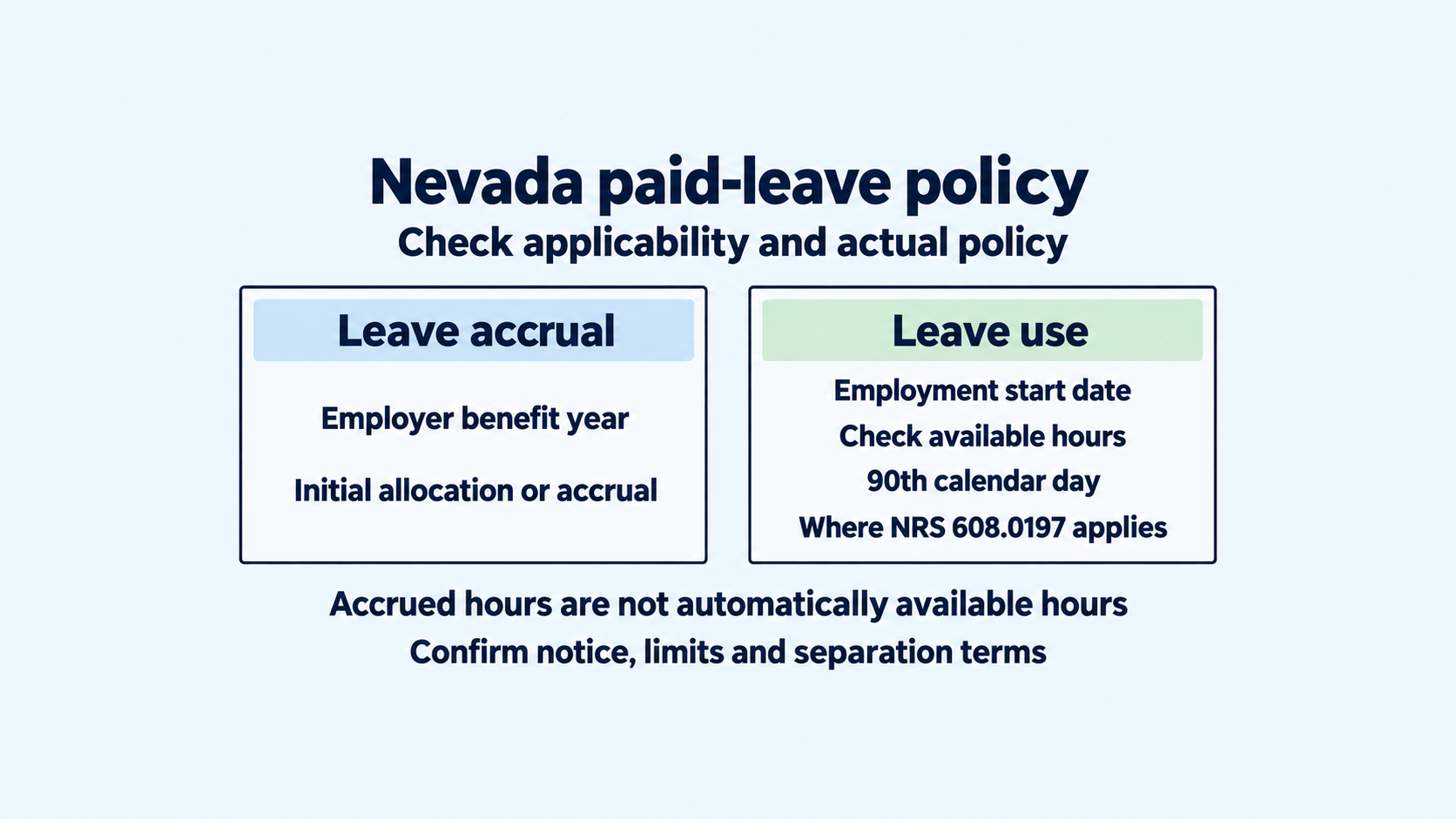
For covered employment to which the section applies, an employee is entitled to at least 0.01923 hours of paid leave for each hour of work performed. The employer determines whether employees receive the year's accrued entitlement on the first day of the benefit year or accrue it over the course of that year. Ask which method the offered policy uses.
A benefit year is the employer's 365-day period for calculating paid-leave accrual. It should not be assumed to be the calendar year or the employee's anniversary year. Identify its beginning and ending dates in the policy. Those dates help explain which hours belong to the balance shown on a statement.
An illustrative calculation is 100 hours of work multiplied by 0.01923, which yields 1.923 hours of paid leave at that rate. This demonstrates the statutory rate, not a particular driver's available balance. A policy that provides hours at the beginning of the benefit year may show a different timing pattern from one that adds hours after work is performed.
Organize actual work records, scheduled hours, payroll periods and employment dates separately when reviewing the leave accounting. Identify which work hours and benefit-year dates the policy uses, and mark any missing records for the leave contact to explain. These records help frame the calculation question; they do not establish that NRS 608.0197 covers the employment.
Check when accrued paid leave becomes available for use
Under NRS 608.0197, an employer must allow an employee to begin using available paid leave on the ninetieth calendar day of employment. The wording refers to calendar days, not ninety completed shifts. Record the employment start date and ask the employer to identify the date it uses for this condition.
Availability and accrual are separate questions. A record can show hours accrued before the date an employee can use them under the section. Conversely, a policy may provide a more generous earlier-use benefit. Ask how the policy distinguishes accrued, available, and used hours so that a displayed number does not become an unsupported assumption about immediate use.
The employer must give each employee an accounting of paid-leave hours available for use on each payday. It may use its payroll system to provide that accounting. Locate the relevant balance and retain the dated statement. If the balance differs from your understanding of the policy, ask about the specific period and calculation.
Understand the permitted use and carryover limits
The statute permits an employer to limit the paid leave an employee uses to forty hours in a benefit year. It also permits a minimum increment for use of no more than four hours. An applicant should ask what limits the actual policy adopts rather than assuming every employer chooses the statutory maximum permitted restriction.
Accrued leave under the over-the-year method may carry over between benefit years, with the employer permitted to limit the amount carried over to forty hours per benefit year. The carryover provision and the annual-use provision address different things. A carryover number does not by itself tell you how much leave can be used in the following year.
When comparing two offers, record the provision each policy uses for accrual, annual use, increments, and carryover. If one document leaves a point unanswered, mark it unanswered and request clarification. Do not calculate a combined annual balance by adding figures whose periods or rules have not been identified.
Ask how notice works without turning it into a reason requirement
NRS 608.0197 allows an employee to use available paid leave for any use, including the listed health and caregiving uses. It expressly allows use without giving the employer a reason. The employee must give notice as soon as practicable. Those provisions distinguish notice of an absence from an explanation of its purpose.
Ask which contact receives the notice and how to send it under the policy. Keep that procedural answer with the leave document. A delivery role may have a dispatch contact for daily assignments and another person for leave administration; the directory does not establish those roles. Obtain the actual instructions instead of assuming the person assigning a route handles every leave question.
The section prohibits denying leave use in accordance with its conditions, requiring the employee to find a replacement worker as a condition of using available leave, and retaliation for using available leave. If a written policy appears to impose a replacement-worker requirement, preserve its wording and ask how it is reconciled with the applicable provision. This guide does not make a finding about an employer's conduct from an isolated message.
Check the leave-pay calculation for the proposed pay method
For hourly employees, the statutory leave compensation rate is calculated from the hourly rate paid by the employer. The section requires payment for available leave used at the applicable rate when the leave is taken and on the same payday those hours would normally be paid. Ask payroll where the leave hours and compensation appear on the statement.
The calculation differs for salary, commission, piece-rate, or other non-hourly methods. NRS 608.0197 uses total wages paid in the immediately preceding ninety days divided by hours worked in that period. Its calculation includes agreed and earned bonuses, subject to the stated exclusions for discretionary bonuses, overtime pay, hazardous-duty additional pay, holiday pay, and tips.
If the proposed offer uses a non-hourly method, request an explanation of that calculation using the applicable records. A route-payment description alone does not produce a reliable leave rate. This guide does not supply a calculated entitlement for an employee whose actual preceding-period hours and compensation have not been reviewed.
Delivery employee FMLA leave eligibility: a separate federal review
The delivery employee FMLA leave eligibility guide explains the separate federal employer, service, hours, worksite, and qualifying-reason checks. It also explains that FMLA leave may be unpaid and that employer-provided paid leave can run alongside it in applicable circumstances. A Nevada paid balance does not establish federal eligibility, and a federal eligibility result does not settle every state or policy benefit.
Ask the leave contact separate questions about the paid hours available under the policy and any federal leave protection relevant to the proposed absence. Keep the answers identified by the rule or policy they address. A general statement that “you have leave” can otherwise leave both pay and job-protection questions unresolved.
Read the separation and rehire provisions before assuming a payout
NRS 608.0197 permits, but does not require, an employer to pay an employee for unused available paid leave at separation. It also requires reinstatement of previously unused available hours when the same employer rehires the employee within ninety days after separation, provided the separation was not due to the employee voluntarily leaving. The conditions matter; the rule does not promise reinstatement after every resignation.
Check whether the actual policy offers a payout or another more generous term. Keep the employer identity and relevant dates if rehire later becomes an issue. Before accepting the current offer, obtain the policy version, the benefit-year dates, the accrual or initial-allocation method, and the contact who can explain an accounting discrepancy.
Source attribution: Nevada Legislature, Nevada Revised Statutes, Chapter 608, section 608.0197, employer-required paid leave, use, records, and exceptions. Federal FMLA discussion is covered in the linked eligibility guide and remains a separate review.