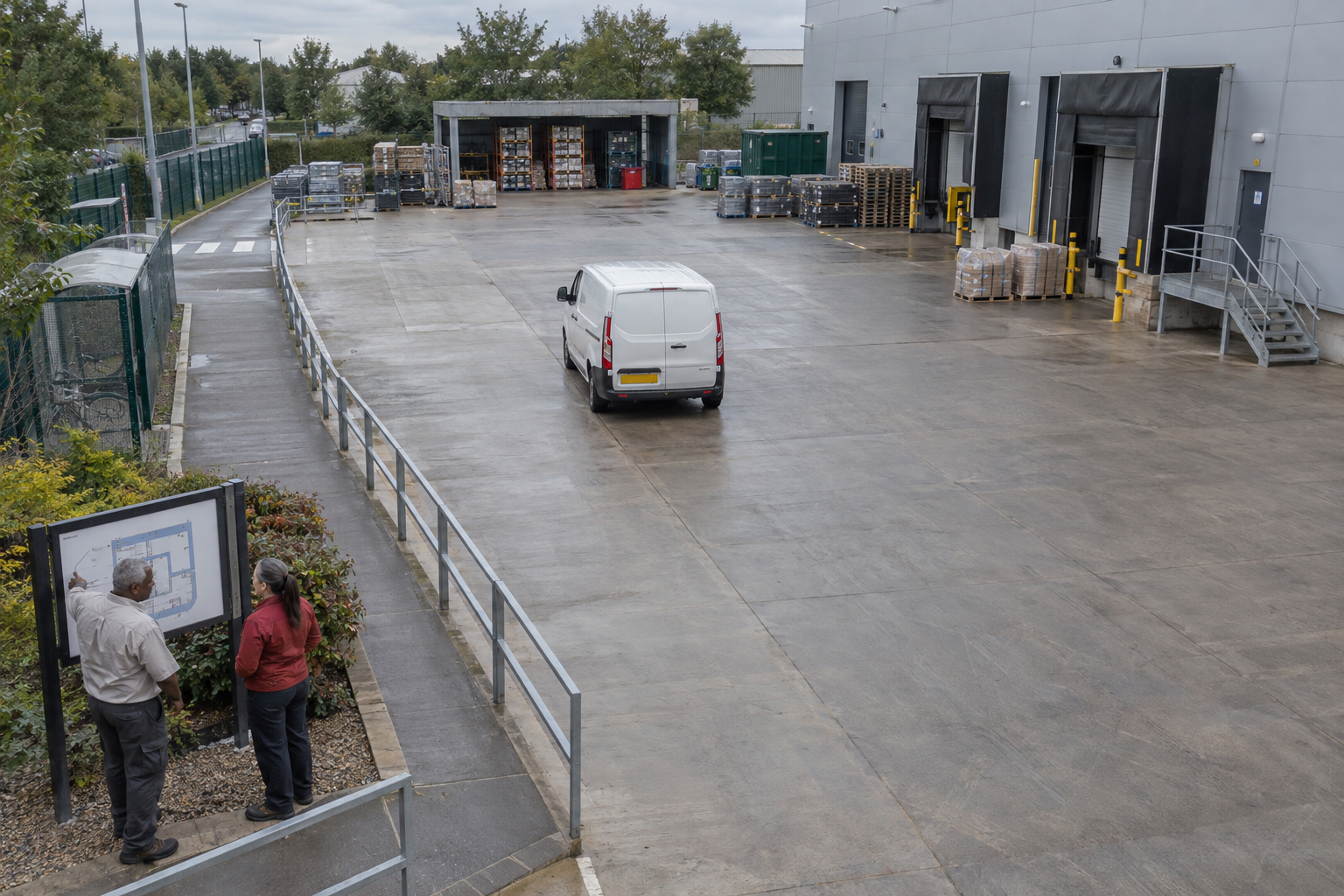
Before backing at a workplace where people can enter the vehicle's blind spot, establish how the movement will be coordinated and how people on foot will stay separate from it. Confirm the site's intended route, understand the visibility limits of the assigned vehicle, and settle any spotter assignment before moving. If those arrangements are unclear, ask the designated workplace contact to clarify them.
A plan for delivery driver backing safety should identify who coordinates the movement and what requires an immediate stop. A camera image or sounding alarm cannot answer every part of that question.
OSHA's material on backovers explains hazards and possible controls. Its backing solutions page identifies its list as informational, not required by an OSHA standard. These sources do not establish that every delivery van must have a spotter or camera, or describe a particular employer's practices. The questions and preparation steps below are practical advice to use with applicable employer and site instructions. OSHA's Backing Safety Solutions provides the source recommendations.
Establish whether the site plan can avoid backing
Start with the intended vehicle route through the workplace. OSHA describes internal traffic control plans as a way for project managers to coordinate equipment, workers, and vehicles so their paths cross less often or do not cross. Such plans can substantially reduce, and sometimes eliminate, the need to back up. That makes route planning an early part of the discussion, before deciding how to carry out a backing movement.
Ask the workplace contact whether an established route or unloading arrangement reduces the need to reverse. If the answer requires changing the delivery approach, get the relevant instructions through the employer's communication process. A driver should not have to invent a site traffic arrangement while trying to interpret where other people are going.
Where backing remains part of the assigned task, clarify how the site separates pedestrian travel from vehicle and equipment movement. Ask where people are expected to walk and who can explain the arrangement around the unloading area. A route description should help you understand both the vehicle's intended destination and the places where foot traffic could enter its path.
Turn a vague instruction such as an unloading location into questions about the actual movement. Does the designated approach involve backing? How is pedestrian access handled during that movement? Who should the driver contact if the observed foot traffic does not match the instructions? These are useful matters to resolve before the vehicle moves.
Learn the blind spots of the assigned vehicle
OSHA identifies several mechanisms behind backovers: drivers may be unable to see a worker in a blind spot, workers may not hear an alarm amid other site noise, and drivers may assume the area is clear. The agency also notes that blind spots around vehicles are not immediately obvious to employees on foot. A person nearby may therefore lack an accurate understanding of what the driver can see. OSHA's Preventing Backovers overview describes these hazards.
For the driver, a useful preparation question is whether training covered the vehicle actually assigned to the work. Ask the employer to explain its blind spots and the use of its visibility equipment. If something about the view is unfamiliar, resolve that uncertainty through the training or instruction process before relying on it during a workplace backing task.
OSHA suggests that training for employees who work around vehicles can include time in the driver's seat to understand the driver's view. It also points to NIOSH blind spot diagrams for various large trucks. Those resources can help explain visibility, while instruction for the assigned vehicle addresses the equipment the driver will use.
Keep the discussion specific: ask which areas cannot be seen and how the employer expects the driver to address that limited view during assigned duties. A general statement that a vehicle has mirrors or a camera leaves those questions unanswered. Someone responsible for instruction should explain how the available views fit into the backing procedure.
Understand what the camera, sensors, and alarm can tell you
OSHA describes cameras as providing a rearward view, with effectiveness depending in part on placement. Its examples include large vehicles that may need multiple cameras to monitor different blind spots. The presence of one display does not establish that the driver can see the entire area around a vehicle.
Ask for the manufacturer's and employer's instructions for the system fitted to the assigned vehicle. Useful questions include what the display covers, what remains outside that view, and how the system is meant to support the employer's backing procedure. If the image does not resolve where people may be, keep that uncertainty part of the conversation with the workplace contact.
Detection equipment also has limits. OSHA explains that radar system placement matters because detection of harmless objects can interfere with detecting a person or object behind the vehicle. The composition of an object can affect radar detection as well. Ultrasonic systems use echoes to detect objects and provide a warning. These descriptions do not support treating the absence of a warning as proof that no person is present.
A backup alarm provides another kind of information, but it does not clear the vehicle's path. OSHA notes that workers may not hear alarms because of other worksite noise or because an alarm is not functioning. The practical implication is to establish pedestrian coordination before movement, without assuming that everyone nearby has heard and responded to the sound.
Settle the spotter arrangement before backing
When the workplace procedure uses a spotter, establish who has that assignment and whether the employer has trained them for it. Treat employer training as a preparation requirement to resolve with the responsible contact. Asking an available bystander to help leaves unanswered whether that person understands the task, the signals, or the surrounding vehicle activity.
OSHA recommends that drivers and spotters agree on hand signals before backing and that spotters maintain visual contact with the driver throughout the movement. It instructs employers to tell drivers to stop backing immediately if they lose sight of the spotter. Confirm these arrangements together before starting, using the signals taught for the work.
The assignment needs the spotter's attention. OSHA recommends giving spotters no additional duties while they are spotting and instructing them to avoid personal mobile phones, personal headphones, and other distractions. It also recommends providing high-visibility clothing, especially during night operations. These are recommendations for employers to address as part of the arrangement.
A driver can ask whether the assigned person is available to concentrate on spotting for the whole movement. If that person is also expected to handle another task, ask the responsible contact to resolve the conflict. A name alone does not establish that someone is ready to carry out the assignment.
Consider the spotter's surroundings during that discussion. OSHA notes that a spotter helping one truck may fail to see another truck behind them. Site coordination must account for the person assisting the driver as well as other pedestrians. Ask the designated contact how the spotting task fits with other equipment movement; do not improvise a standing position for an untrained helper.
A hypothetical unloading-yard stop with unclear instructions
Consider this explicitly hypothetical example. A delivery driver arrives at an unloading yard where the assigned unloading task appears to involve backing. People are walking through the area. Someone nearby gestures toward the unloading location, but the driver has not been told whether a spotter is assigned or how pedestrian movement will be coordinated.
The driver keeps the vehicle stationary and contacts the designated workplace representative through the available work communication process. The message is specific: people are walking through the intended movement area, and the spotting arrangement is unclear. The driver asks whether the site's planned approach can avoid backing and, if backing is necessary, how pedestrian access will be handled.
Suppose the representative confirms that the site procedure calls for a spotter. The driver then asks who is assigned, whether the employer has trained that person, and whether they are free from competing duties. The earlier gesture toward the unloading location does not answer any of those questions. The representative needs to clarify the assignment before the driver can establish the agreed communication.
Next, the driver and assigned spotter review the signals taught for the task and confirm the requirement to maintain visual contact. The driver also asks how the vehicle's camera should be used under the employer's instructions. The preparation remains incomplete if the pedestrian arrangement is still unresolved, even after the spotter is identified.
This hypothetical stop ends at the decision about readiness: the driver has either received the needed instructions or continues to seek clarification before movement. It makes no claim about a particular company's procedure or a guaranteed outcome. If backing subsequently begins and the driver loses sight of the spotter, the driver stops backing immediately.
Delivery shift instructions for backing and stop conditions
Confirm the receiving site’s current unloading directions and who can clarify an unclear instruction before moving the vehicle. The guide to delivery shift instructions explains how to identify the assignment and reporting contacts. A direction to use a particular area does not replace checking that the backing path is clear and following the safe movement procedure.
The published McKinney profile for ASC3 Logistics LLC identifies a TX DSP business to contact. Ask about the assigned vehicle, site instructions and person responsible for resolving a backing question. The directory entry does not establish a current vacancy or the arrangements for an individual assignment.
The McKinney profile for Ace Logistics and Transport LLC identifies a second DSP business in the same region. Confirm the employing entity and request the actual role’s written terms. Direct questions about the assigned vehicle, site instructions and person responsible for resolving a backing question to its responsible contact.
Questions to resolve before movement
Use these questions with the responsible workplace contact and, when assigned, the trained spotter. They turn an unclear backing task into matters that someone can answer before the vehicle moves:
- What is the site's intended route, and can the delivery arrangement reduce or eliminate backing?
- How will people on foot remain separate from the vehicle's movement, and who coordinates that arrangement?
- Do I understand this assigned vehicle's blind spots and the manufacturer's and employer's instructions for its visibility or detection equipment?
- If the procedure uses a spotter, who is assigned, has the employer trained them, and are they free from other duties and distractions?
- Have the spotter and I agreed on the signals and the visual contact needed throughout the movement?
- Whom do I contact if an instruction is unclear or the observed site activity does not match the arrangement?
Keep unresolved answers with the designated contact before beginning the backing task. During backing with a spotter, apply OSHA's stated stop condition: stop backing immediately if you lose sight of the spotter. Resolve the loss of contact and reestablish the agreed arrangement before considering further movement.