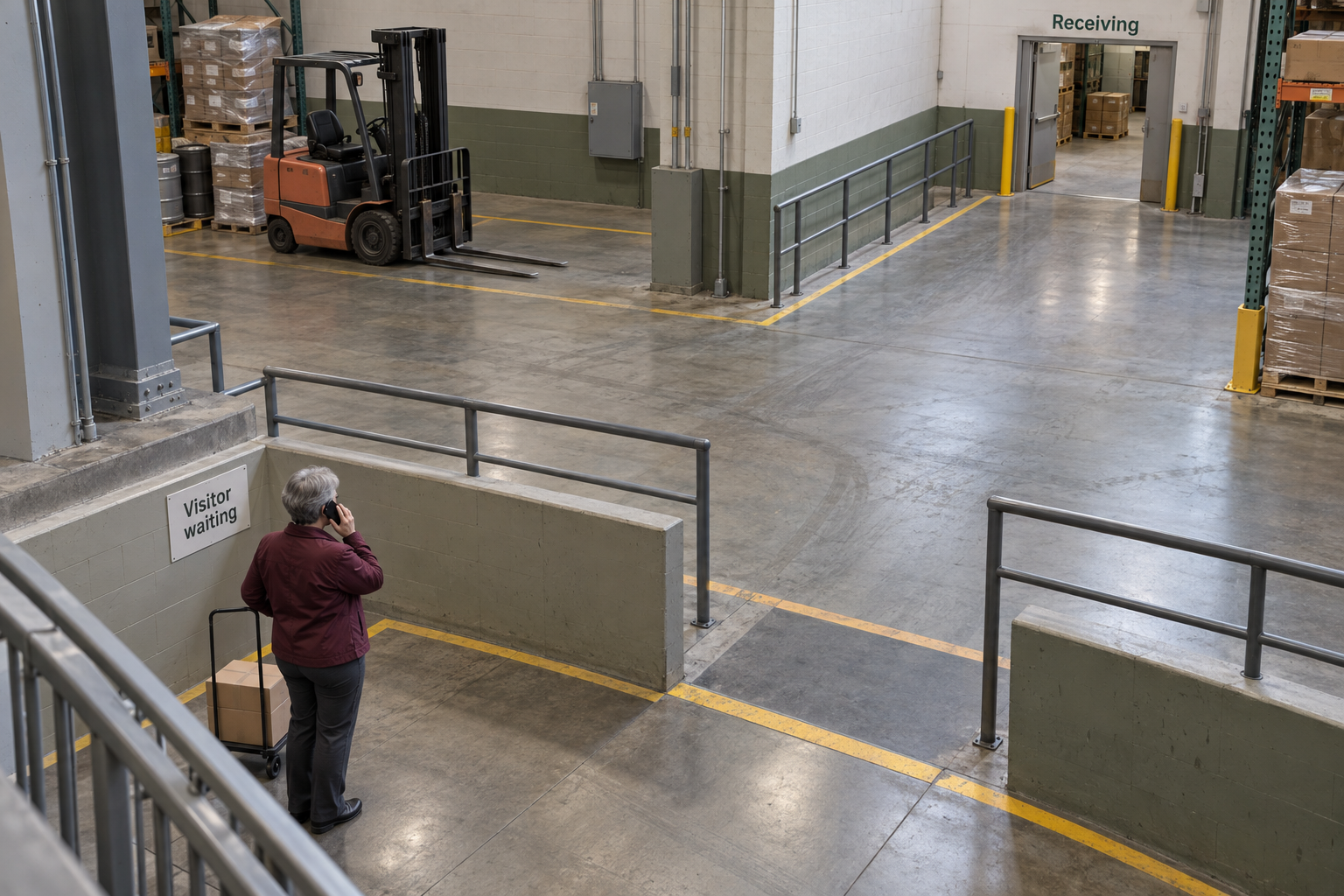
Loading-area pedestrian separation starts before a visiting delivery worker steps into a truck operating area. Establish the route from your arrival point to the receiving contact, identify any crossings, and confirm where to wait. If the route is unclear or blocked, ask the receiving contact for directions from a place outside moving traffic.
A delivery address may identify the correct building while leaving the walking approach unresolved. Before carrying anything inside, establish how you will cross the work area and return to your vehicle. The receiving contact needs to give directions a visiting worker can recognize, including any point where pedestrian and truck routes meet.
Separate the federal baseline from visitor advice
OSHA's powered industrial truck standard addresses employer responsibilities, operator training, and truck operation. The requirements discussed here are federal general-industry baselines where applicable. They do not establish universal coverage at every Arizona workplace or private customer site. State Plans can differ; this guide does not identify additional Arizona requirements.
In 29 CFR 1910.178, paragraph (l)(3)(ii)(D) includes pedestrian traffic among workplace topics for operator training, subject to the standard's applicability provisions. Paragraph (n)(4) requires drivers to slow down and sound the horn at cross aisles and other places with obstructed vision. Paragraph (m)(2) prohibits anyone from standing or passing beneath an elevated portion of a truck, whether loaded or empty.
The visitor steps below are practical precautions for arranging access and communicating with the receiving contact. The standard does not prescribe a particular visitor check-in script, walkway color or universal pedestrian clearance distance.
Establish the route at arrival
Before walking toward a loading door, use the arrival instructions you have to locate the visitor entrance or receiving contact. State where you are and where the delivery needs to go. Ask the contact to describe the pedestrian approach, including any point where it crosses truck traffic. A destination such as a desk or loading bay does not, by itself, explain how to reach it.
Make the directions concrete enough to recognize on the ground. Useful details include the door identifier, the posted pedestrian path, and the place where someone will meet you. If the answer relies on a landmark you cannot see, say so. Avoid walking into the operating area merely to find someone who can explain it.
Read posted routes before following other people
Look for instructions governing pedestrian entry and follow the route identified for your visit. Where markings or signs are ambiguous, ask what they mean. The presence of a painted line does not tell a first-time visitor whether it marks a walking route, equipment position, or another boundary. Someone else walking through a gap also does not establish that the gap is your designated approach.
Confirm where the route ends. You may have clear directions to a doorway but still need instructions for reaching the receiving person inside. Ask whether to remain at that doorway, wait for a staff member, or continue along a specified path. This avoids having to improvise the final few steps beside active equipment.
Before carrying the delivery along the route, consider whether you can see where you are walking and stop at the identified waiting point. If the proposed handoff requires carrying an item through an unclear crossing, explain that to the contact. Request an arrangement that lets you follow the pedestrian instructions without losing sight of the path.
Resolve crossings and blind corners
OSHA assigns truck drivers duties at obstructed locations. In addition to slowing and sounding the horn under paragraph (n)(4), drivers must look in the direction of travel and keep a clear view of the travel path under paragraph (n)(6). These operator requirements are useful context, but a visiting worker still needs to know how the site's pedestrian crossing works.
At a crossing, establish where to stop before entering the truck path. Ask the receiving contact how pedestrians and operators communicate there and whether someone needs to meet you. If a wall, load, or doorway hides the approaching lane, remain outside it while resolving the crossing. Stepping into the lane to obtain a better view defeats the purpose of stopping before it.
Treat a horn as a warning of truck activity. It does not tell you that a crossing is clear. Likewise, eye contact or a hand gesture alone may leave the intended movement unclear. Follow the site's crossing procedure and clarify an ambiguous signal before moving. Keep attention on the whole crossing, including the route beyond the first truck.
Hypothetical example: a receiving desk beyond a blind corner
Suppose your directions identify a receiving desk just past a doorway, but a stack beside the doorway prevents you from seeing the intersecting aisle. You hear a horn from inside. Remain at the identified waiting place and contact receiving. Explain that you cannot see the crossing and ask someone to meet you or explain an alternative pedestrian approach.
In this example, the problem is the missing connection between your waiting place and the desk. Repeating the desk's location would not resolve it. A useful response would specify how you reach it while truck movements are controlled, or arrange the handoff somewhere accessible without that crossing. This is a hypothetical application of the advice, not a description of an employer's practice.
Keep every route clear of elevated equipment
The rule in OSHA paragraph (m)(2) applies beneath an elevated portion of a truck even when it carries no load. Empty raised forks therefore do not create an acceptable shortcut. The wording also covers standing underneath, so a person cannot use that space as a temporary waiting place.
Practical advice: if raised forks interrupt the intended path, stop outside the affected area and ask the receiving contact to resolve the route. Do not duck underneath, squeeze through because the delivery is small, or regard an operator's gesture as an exception to the prohibition. Continue only after there is an appropriate pedestrian route that does not take you beneath elevated equipment.
Keep the same boundary when retrieving paperwork or an item that has been set down. A brief task still involves entering the space. Tell the contact what you need to collect and ask for it to be brought to the agreed handoff point, or for the route to be made usable before you proceed.
Choose a waiting place that stays outside the work
A delivery visit can involve waiting while someone checks the shipment or finds the recipient. Ask where to stand during that interval. Specify that you need a pedestrian waiting place outside the truck travel and loading activity. The spot where you first meet someone may be suitable for a brief conversation without being suitable for a longer wait.
OSHA paragraph (m)(1) prohibits driving trucks up to anyone standing in front of a bench or another fixed object. As a practical precaution, avoid choosing a waiting position between an approaching truck and a wall, bench, or similar obstruction. If a receiving task would put you there, ask the contact to move the interaction to the designated waiting or handoff place.
Keep the delivery and any paperwork with you at the agreed location without spreading into the walking route. If a signature or device requires your attention, complete that exchange while stationary outside the operating path. Tell the recipient where you will wait so they do not expect you to follow them through the loading activity.
Hypothetical example: the posted path is blocked
Suppose the receiving contact directs you along a marked pedestrian path, but a pallet now occupies part of it. The available gap would put you into the adjoining truck lane. Stop before the obstruction and report its location. Ask for the path to be cleared or for a specific alternative route.
If the answer is simply to go around, explain where that would take you. A usable instruction should resolve the crossing or detour, including where you rejoin the pedestrian path. In this hypothetical situation, waiting for clarification prevents a route established at check-in from becoming an improvised walk through equipment traffic.
Operator requirements remain with the operator and employer
Under OSHA paragraph (l)(1), the employer must ensure that each powered industrial truck operator is competent to operate safely through the required training and evaluation. The training provisions address truck characteristics and workplace conditions. A visitor asking for walking directions is not performing that evaluation and cannot establish an operator's competence from a short interaction.
Practical advice: keep your request focused on pedestrian access. Ask who can confirm the walking route, arrange the handoff, or coordinate a crossing. If you are asked to move powered equipment to get through, explain that you are there to make the delivery and request assistance from the person responsible for that equipment. A delivery instruction alone does not establish that you meet the operator requirements.
Avoid converting truck rules into invented pedestrian measurements. For example, paragraph (n)(1) describes approximately three truck lengths of following distance between trucks. It does not establish a universal distance for a person walking beside a truck. Obtain the site's pedestrian separation instructions instead of treating that figure as a walking clearance.
Report a route problem precisely
If the planned route cannot be used, give the receiving contact enough detail to locate the problem. Identify the entrance or crossing, describe what blocks passage, and state where you are waiting. A report such as an obstruction across the marked path conveys more than saying the loading area feels busy.
Separate what you observed from what you need. You can report that the path requires passing beneath raised forks without making a broad finding about the entire workplace. Then request a usable pedestrian approach or a different handoff point. If the contact cannot resolve access, communicate the delay to your own work contact and ask for the next delivery instruction while remaining outside the affected area.
Record directions that will matter on the return trip, especially if the entrance arrangement has changed. Before leaving the receiving point, confirm how to get back to your vehicle. A temporary pause that allowed the inward crossing may have ended, so the return needs its own clear passage.
Delivery workplace walking surface hazards along the route
A route through a loading area may also have delivery workplace walking surface hazards, such as a damaged step or obstructed passage. Report the precise location and explain how it affects the planned handoff or return trip.
If the pedestrian path is damaged or obstructed, the guide to delivery workplace walking surface hazards explains how to identify the affected section, report the interrupted movement and request verified access before proceeding. Give the receiving contact the surface location as well as the crossing or truck-traffic problem, so an alternative route resolves both conditions.
When comparing Arizona delivery employers, use the published profile for Trifecta Logistics LLC in Phoenix as a starting point for questions about receiving visits. Ask the hiring contact whether assigned work involves customer loading areas, who supplies pedestrian arrival instructions and how a driver reports an unusable route. The directory profile does not establish the company’s present vacancies, safety procedures or customer-site arrangements.
The published Phoenix profile for Kartable Logistics LLC provides another Arizona DSP contact to research. Ask about walking handoffs and receiving-site access before accepting an assignment. Both profiles list Phoenix locations. Confirm where any proposed assignment would take you, and obtain access instructions from the contact responsible for each delivery visit.
Leave arrival with a usable route
For your next delivery, put the receiving contact and pedestrian entrance in your arrival notes. At check-in, confirm the route to the handoff and back to your vehicle. If any segment would take you beneath raised equipment or into an unresolved truck crossing, remain at the agreed waiting place and have that segment resolved before continuing.